Showing posts with label Government. Show all posts

Tuesday, September 1, 2009

China's Policy Paper on Latin America and the Caribbean - MercoPress Analysis

[Source] -- MercroPress

On November 5, 2008, the Chinese government released a policy paper on Latin America and the Caribbean, as it had previously done so for Europe in 2003 and for Africa in 2006.

Although it may not come as a huge surprise that Latin America is the most recent region for which China has formally spelled out its foreign policy position, the region has been historically perceived as being under the United States’ sphere of influence. Perhaps the importance of the Chinese policy paper lies in the timing of its release. The release of the paper deliberately coincided with the unfolding of the current financial crisis; this congruence of events has allowed China to expand its influence in this somewhat neglected region without attracting any lasting venom from the U.S. China’s policy paper formally evidences the importance of Latin America and the Caribbean as part of China’s growth plan for its long-term strategic interests. Most of all, this includes access to raw materials as well as a plethora of natural resources, the infiltration of new foreign markets, the reduction of diplomatic support for the Republic of Taiwan, and the strengthening of Beijing political standing on the global stage through strong alliances cemented with the developing world.
The policy paper’s general context

The policy paper explicitly states its main objective is to “clarify the goals of China’s policy in this region, outline the guiding principles for future cooperation […] and sustain the sound, steady and all-around growth of China’s relations with Latin America and the Caribbean.” In the economic realm, China expresses an interest in investing in energy, mineral resources, forestry, fishing and agriculture, areas important to expanding China’s productivity. Additionally, the Chinese government seems to show interest in infrastructure projects not directly related to its economy, albeit essential in the transportation of natural resources, and proposes to fund these projects in order to be perceived as a partner in development. Furthermore, China expresses its desire to increase military diplomacy and sale of equipment to the region. Although many of the report’s statements are merely rhetoric and general in scope, the paper helps formalize China’s economic, diplomatic and military ties with Latin America, which were first proposed by then President of China Jiang Zemin in 2001.

The policy paper was released against the backdrop of the current financial crisis and the corresponding economic hardships that have severely hit the U.S. and Europe. Its publication deliberately coincided with the emergency G-20 meeting to discuss the economic crisis that was about to take place in Washington. More importantly, it preceded Chinese President Hu Jintao’s visit to Peru for the November 2008 Asia-Pacific Economic Cooperation (APEC) summit, at which he presented China’s foreign policy towards Latin America. This timing of the paper’s release was especially important for the countries seeking to diversify their export markets and decrease their dependence on declining Foreign Direct Investment (FDI) from the US and Europe. With the vast foreign reserves accumulated by China –which totalled US $1.95 trillion in December 2008– the region had valid reasons to closely follow the summit’s developments.

To access this article in full you must register for MecroPress's website.

Once you register, click here for a direct link to this article

Share/Save/Bookmark

Monday, August 31, 2009

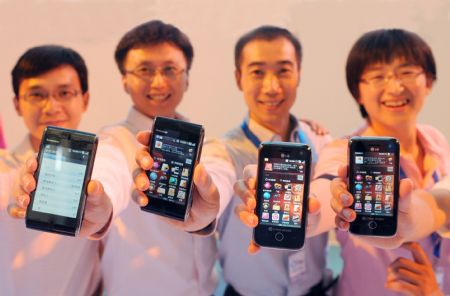
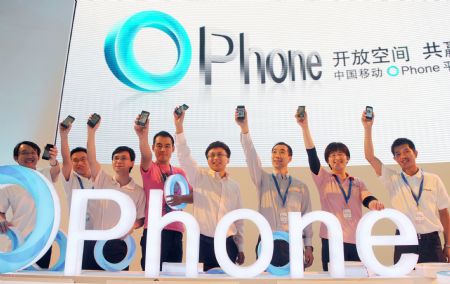
China Mobile's OPhone debuts in Beijing

Can anyone else catch that intense aroma of bootleg in the air? I don't mean to point fingers at China because hey... all the major mobile company's around the world have made Iphone / smart phones that are comparable to the Iphone.

These phones are China's homegrown challenge to the Iphone which has finally reached a "non-exclusive" agreement with China Unicom, which will be the initial carrier Apple works with in the mainland.

Employees of China Mobile show off different designs of OPhone
handsets at the first-issuing ceremony in Beijing, China, August 31, 2009.
(Xinhua/Yuan Zhou)

(Xinhua/Yuan Zhou)

I say... Let the competition begin. I just wonder if something shady is going going on behind the scenes because China Mobile and China Unicom are more like reflections of one another in terms of their company structure and place in the Chinese economy. Yes, China Mobile is bigger and has far great market share, and yes both company's have separate management and are traded on different tickers on various stock exchanges.

Nonetheless, the government has a heavy hand in both and I wonder how Apple is dealing. A friend of mine who is quite observant and logical once told me

"Government wants two big company's to make illusion of real competition, but read story is two company's mean more important jobs for people with connections and image of fair market."

I personally own shares of China Unicom ADR here in the states. Meaning... despite what people tell me about the real situation with telecoms in China, officially, I buy into the hype.


China Unicom (CHU) -
Year to date performance Aug 31, 2009


Share/Save/Bookmark

Monday, May 18, 2009

Beijing's shady underground scene

Beijing, China—the capital of the People's Republic of China, is no place for puritans. The city's underground scene of sex, drugs and rock & roll is growing faster than Chinese GDP these days.

“China High, my fast times in the 010—A Beijing Memoir by ZZ,” is a new book detailing the adventures of a young expat lawyer who lived in Beijing during the years of China's fast economic growth since the founding of the People's Republic in 1949.

Bloomberg columnist Le-Min Lim reviewed the book on May 14 and had the following to offer.

~~~~~~~~~~~~~~~

“Written before the global credit meltdown, “China High” lifts a curtain on a side of Beijing seldom seen by tourists. ZZ captures the nocturnal buzz of a city where rave parties in derelict factories are a staple and orgies have become a rite of passage. Then there’s the pot, which locals call the Big Numb.

Beneath the froth lies a serious message: The world’s largest developing economy is seething in social tension, displaced people and hypocrisy. It’s a land of official sexual equality run by men who often keep under-30 mistresses, a.k.a. their “little honeys,” on two-year contracts. A country given to bouts of xenophobia among people who fawn on foreigners.”

ZZ offers tips on how to navigate Beijing, right down to what the worst swear words mean and how to use them to best effect. He exposes the hidden high costs of doing business in labor-rich China by describing his struggle to start a food- delivery company staffed by locals with little English and no inkling of quality service.

~~~~~~~~~~~~~~~~~~~~~~~~~~~~~~~~~~~~

So you get the picture? Beijing is more than the city which hosts China's most famous historical monuments, shiny new sky scrapers and Olympic arenas. Beijing like other major metropolises in the world (ie: London, Paris and New York) has its own dark side to it.

The book also sheds light onto another, equally important facet of expatriate life in China for a foreigners working or studying in the country's major cities. The “ego trip,” anyone from the plains of Iowa to a pompous New Yorker or Londoner will experience upon moving to China.

A Chinese-Laotian-American friend of mine was sitting with me at a Mexican restaurant in Beijing one day back in 2006 when I asked him what his thoughts on why the Chinese treat foreigners so well and virtually hand us all this privileged their own citizens don't enjoy.

“Well Bennett, the Chinese were sitting on top of the world for a few thousand years and one day these random barbarians (Europeans) showed up and knocked China off its pedestal. Political and social turmoil aside, the Chinese pride was damaged so badly, they have been in a never ending state trying to catch up and keep peace at the same time. That is why, at least until China does catch up, foreigners will be welcomed with open arms.”

At the moment, living as a foreigner in Beijing and other big cities like Shanghai has its downsides as all places do. This usually comes in the form of having to deal with bureaucracy, regulations you did not know existed or other headaches that are typical of life in a developing country.

On the other end of the spectrum exist some great perks you can not find just anywhere. The common foreigner will suddenly feel as if they have taken the express elevator up the social latter of life. ZZ explains: 

“What does work wonders is being a foreigner, he says, rightly observing how the Chinese, long cut off from the world, now revere all things from abroad. An expatriate, he says, draws praise, envy and opportunity just for being different. “

It’s “the perfect recipe for an ego trip,” he writes.


~~~~~~~~~~~~~~~~~~~~~~~~~~~~~~~~~~~~

To purchase your own copy and read more detailed reviews please visit Amazon or Barnes and Noble.


Share/Save/Bookmark